Will AI Take My Job? 5 Moves to Future-Proof Your Career
The question nobody wants to say out loud
You've read the headlines. You've watched a colleague's role quietly disappear during a "restructure." Maybe you've noticed that your own job description has drifted — more reviewing, more approving, less of the work you were actually hired to do.
And somewhere in the back of your mind is the question you don't ask in team meetings:
Am I next?
Here's what I want you to know before we go any further: that question is not paranoia. It's pattern recognition. And pattern recognition is exactly the skill that's going to carry you through the next five years.
But the answer to the question is more interesting — and far more actionable — than the headlines suggest.
What the data actually says (and where the headlines get it wrong)
Let's separate signal from noise.
The net number is positive. The World Economic Forum's Future of Jobs Report projects that by 2030, roughly 170 million new roles will be created globally, while about 92 million roles will be displaced — a net gain of around 78 million jobs. Twenty-two percent of all jobs will be structurally transformed.
But "net positive" is cold comfort if you're in the 92 million. New jobs don't automatically go to displaced workers. They go to people who were ready for them. That gap — between the jobs disappearing and the people qualified to fill the jobs appearing — is the entire story of the next five years.
The skills clock is the real deadline. The same research finds that roughly 40% of the skills required in today's roles will be transformed or obsolete within five years. Not your job. Your skills. That's a much faster clock than most people are planning around.
Employers already know this. Around 85% of employers say upskilling their workforce is their primary strategy — and 63% name the skills gap as the single biggest barrier to their own transformation. Read that again, because it's the most important sentence in this article: your employer's biggest problem is finding people who can do the new work. You can become the answer to that problem.
And in 2026, the disruption looks quieter than expected. It's rarely a dramatic "replaced by a robot" moment. It's fewer junior openings. Smaller teams. Slower backfills. Higher output expectations on the people who remain. Entry-level and routine white-collar work — data entry, basic analysis, first-tier support, routine administrative coordination — is absorbing most of the pressure, while senior people take on broader scope and supervise AI-assisted output.
If your role involves processing information in predictable patterns, you are in the exposure zone. If your role involves judgment, persuasion, relationships, ambiguity, and accountability, you are in the augmentation zone.
Most of us are in both. That's the actual situation.
The reframe that changes everything: AI doesn't take jobs, it takes tasks
This is the single most useful mental model I give clients, and it comes straight out of how automation has actually moved through organizations for the last decade.
Jobs are bundles of tasks. AI doesn't eliminate the bundle — it dissolves specific tasks inside it. What's left is a smaller, denser, more human bundle, plus a new set of tasks nobody had five years ago: prompting, verifying, escalating, governing, and explaining AI output to people who don't trust it yet.
So the useful question isn't "Will AI take my job?"
The useful question is: "Which of my tasks are dissolving, which are becoming more valuable, and what new tasks can I claim before someone else does?"
That's a question you can actually answer. And once you answer it, you have a plan instead of a fear.
What stays human
There's a reason my company is called HumanKind, and a reason the "Stay Human" line runs through everything we make.
The capabilities compounding in value right now are not the ones we spent twenty years telling people were "soft":
- Judgment under ambiguity. AI is confident. It is not accountable. Someone has to own the call.
- Trust and relationship. People buy from, follow, and confide in people. That has not moved.
- Translation. The most valuable people in AI-adopting organizations are the ones who can stand between the technical and the human and make both sides understood.
- Ethical reasoning and governance. Every organization deploying AI needs people who can ask "should we?" as fluently as "can we?"
- Change leadership. Adoption fails on culture, not technology. Resistance to change is one of the top barriers employers report.
- Creative problem framing. AI answers questions well. It doesn't decide which question matters.
These are not consolation prizes for people who can't code. In an AI-saturated market, they are the scarcity.
The winning profile isn't "human"
or "technical." It's the hybrid: a person with deep domain expertise, real human capability, and enough AI fluency to direct the tools instead of being directed by them.
The 5 moves that future-proof a career
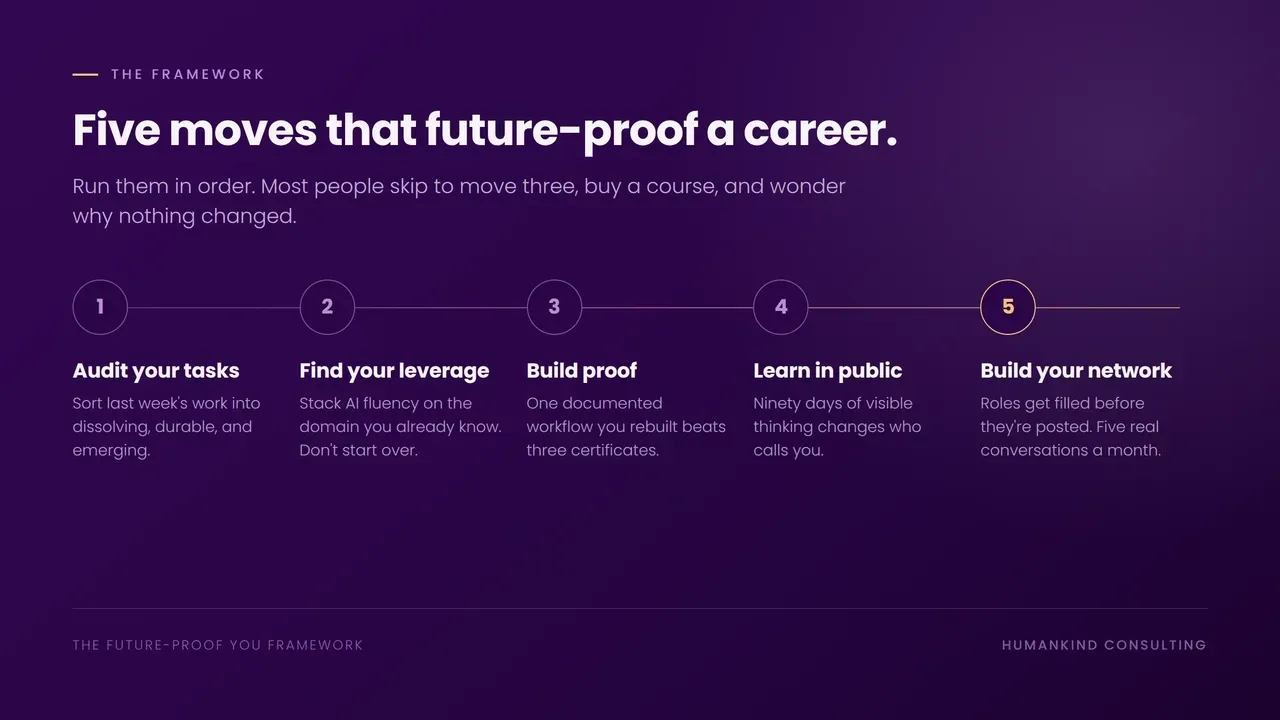
Here's the framework I walk clients through. It's deliberately sequential — most people skip to step four, buy a course, and wonder why nothing changed.
1. Audit your tasks, not your title
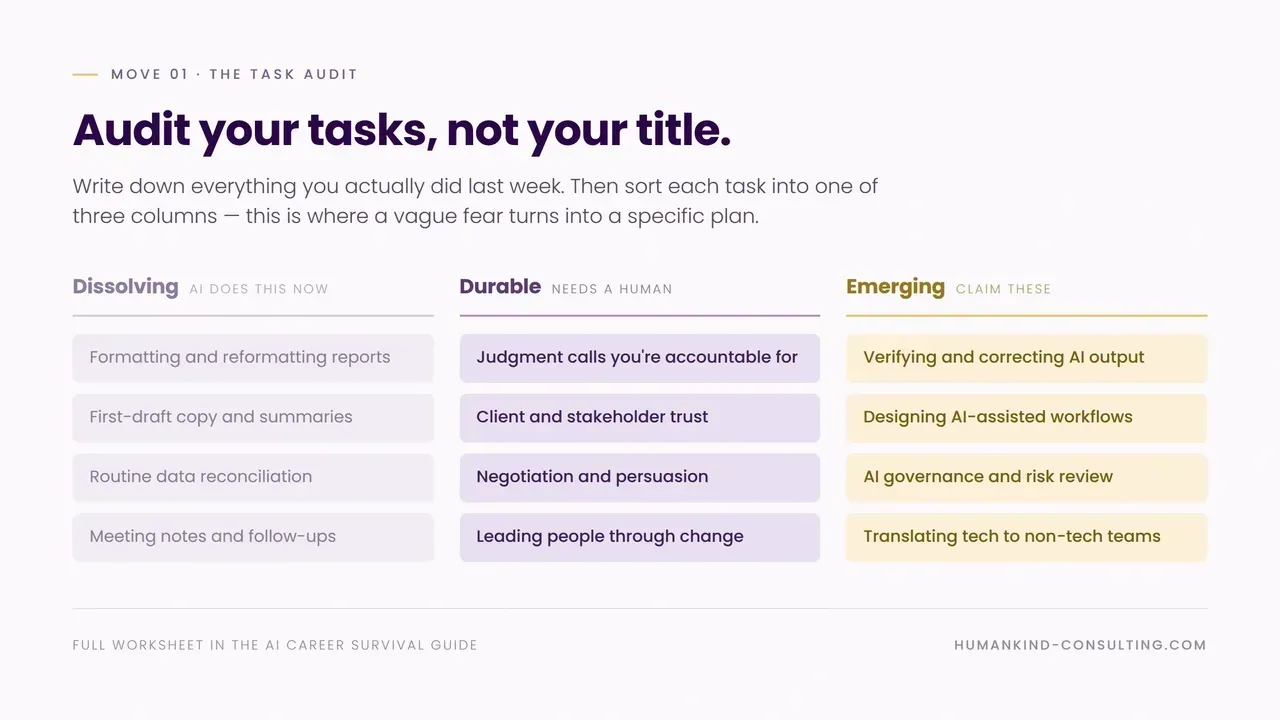
Write down everything you actually did last week — every task, in plain language. Then sort each one into three columns: Dissolving (AI can do a credible version today), Durable (requires judgment, relationship, or accountability), Emerging (didn't exist in your role three years ago).
Most people are shocked by how much of their week sits in column one. That's not bad news. That's your reclaimed capacity.
2. Find your leverage point
Your advantage is almost never "learn to code." It's your domain expertise plus AI fluency. A nurse who understands clinical workflow and AI is more valuable than a generalist prompt engineer. A finance manager who can spot where a model is quietly wrong is irreplaceable. Stack AI on top of what you already know. Don't abandon what you know to chase what's trendy.
3. Build proof, not credentials
A certificate says you sat through something. A portfolio says you did something. Automate a real workflow in your current job. Document the before, the after, and the hours saved. One concrete artifact — a process you redesigned, a tool you built, a pilot you ran — outperforms three certifications in every hiring conversation I've ever observed.
4. Learn in public
The people getting recruited right now are the ones whose thinking is visible. Post what you're testing. Share what failed. Ninety days of consistent, specific, useful posting about your domain and AI will do more for your options than a year of quiet studying.
5. Build the human infrastructure
Roles are increasingly filled before they're posted. Your network is your early-warning system and your on-ramp simultaneously. Five genuine conversations a month with people doing work adjacent to yours will surface opportunities that never reach a job board.
Not sure which of your tasks are at risk?
Download the free AI Career Survival Guide + Future of Work Report — including the task-audit worksheet from Step 1 and the exposure scoring model we use with clients. [Get the free guide ]
Three myths worth retiring
"I'm too senior for this to affect me." Seniority protects you from the first wave and exposes you in the second. Leaders who can't speak credibly about AI governance, adoption, and workforce planning are already being screened out of executive searches.
"I'll wait until my company decides on its AI strategy." Your company's AI strategy is a plan for the company. It is not a plan for you. Those are different documents, and only one of them has your name on it.
"I'm not technical." Fluency is not engineering. You do not need to build the model. You need to know what it's good at, where it lies, when to escalate to a human, and how to hold it accountable. Most professionals can reach useful fluency in weeks, not years.
Frequently asked questions
Which jobs are most at risk from AI? Roles built around predictable information processing: data entry, routine bookkeeping and reconciliation, first-tier customer support, basic reporting and analysis, and routine administrative coordination. Entry-level white-collar work is under the most pressure because AI absorbs exactly the tasks junior staff traditionally learned on.
Which jobs are safest? No job is untouched, but roles anchored in accountability, physical presence, and human trust are the most durable — skilled trades, healthcare delivery, therapy and counseling, education, executive leadership, complex sales, and any role where a human must own the consequences of a decision.
How long do I have to reskill? The realistic planning horizon is 12 to 24 months for meaningful repositioning, and about five years before a large share of current role-specific skills are transformed. Most people need far less time than they fear — but they need to start sooner than feels comfortable.
Should I get an AI certification? Certifications help you learn and signal intent. They rarely close a deal on their own. Pair any certification with one documented, real-world application of what you learned. The application is what gets you hired.
What if I've already been displaced? You are not behind — you are early, and you have something most employed people don't: time and clarity. Displacement is one of the fastest routes into a repositioned career when it's handled with a plan instead of panic.
The bottom line
AI is not the end of human work. It is the end of a particular kind of human work — the repetitive, predictable, pattern-following kind that most of us never loved anyway.
What's left is the work that requires you to be a person: to judge, to persuade, to care, to decide, to be accountable. That work is not shrinking. It's becoming the whole job.
The people who thrive between now and 2030 won't be the ones who out-computed the machines. They'll be the ones who got specific, moved early, and stayed human.
Ready to find out exactly where you stand?
Book a free 20-minute AI-Readiness Conversation. We'll map your current role against AI exposure, identify your three highest-leverage moves, and build a first-90-days plan you can start on Monday.
[Book your free conversation]
Or explore:
AI-Readiness Assessment & Career Mapping — a full diagnostic of your task exposure, transferable strengths, and target roles
Personalized Learning Pathways — a curated skill roadmap built around your domain, not a generic course list
Sources: World Economic Forum, Future of Jobs Report; Goldman Sachs generative AI economic research; McKinsey Global Institute; Challenger, Gray & Christmas layoff tracking; U.S. Bureau of Labor Statistics.
Elon Musk is worried about AI apocalypse, but I am worried about people losing their jobs. The society will have to adapt to a situation where people learn throughout their lives depending on the skills needed in the marketplace.
— Andrew Ng
Recent Posts